
PHOTOELECTRIC EFFECT
One of the great problems of classical physics in the late 19th century was explaining what happened when a beam of light was placed on a metal plate. It is worth remembering that at this time the complete theory of quantum mechanics did not yet exist.
In order to explain the phenomena involving atoms and other small particles, statistical mechanics was developed, a way of treating such problems in a classical way, making use of classical mechanics.
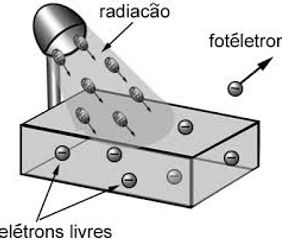
The phenomenon, called the photoelectric effect, relates to removing an electron from the outermost layer of a metal using a beam of light. At the time, the light was still understood as an electromagnetic wave, and it had to be that the greater the intensity of the light, the greater the amount of energy it carried. Using the classic mechanics of the time, the result was that regardless of the frequency of the light, whenever light was applied to a metal, it was possible to increase the intensity of the beam in order to pull electrons out of the material. It was possible to measure the energy of the plucked electrons using a voltmeter.
However, that was not what the experiment showed. When a beam of monochromatic light (single frequency) was placed on a metal plate, the electron may or may not be pulled out of the metal. If it were, such an electron would have a defined energy, and the fact of increasing the intensity of the light did not result in pulling out electrons with different energies, but only a greater amount of electrons with the same energy as before. If the electron was not pulled out by the incidence of light, increasing the intensity of the light also did not result in starting to pull electrons out of the metal. In addition, if the frequency of the incident light were varied in a decreasing manner, for a given metal there was always a frequency, called the cutoff frequency, for which below it it was not possible to remove electrons from the metal, regardless of the intensity of the light. Thus, the theory was in complete disagreement with the experiment. Below the images there is a simulator to interact .

According to Einstein adopting the Planck constant, the equation for the Photon is ...
Where h- planck constant, ν- frequency and φ- work function
What Einstein meant about this equation is that, for a given very low frequency, it would not be enough to pull an electron out of the plate regardless if we increase the intensity of that light at the same frequency. But if we focus on the metal plate a light that has a very high frequency, consequently electrons would come off this plate, and if the light intensity increases at a high frequency, the greater the amount of electrons that will be released. The term (φ) - work function that appears in this equation tells us that there is a minimum value to be able to remove the electron from the plate, that is;
(h .ν) < φ
if (h .ν) is less than (φ) the electrons will not leave the plate
(h .ν)> φ
if (h .ν) is greater than (φ) the electrons will leave the plate.
Albert Einstein with this experiment says that light is simply not just particle and wave, but both! For some phenomena light has a wave behavior and for others it has a corpuscular behavior.
Albert Einstein with this experiment says that light is simply not just particle and wave, but both! For some phenomena light has a wave behavior and for others it has a corpuscular behavior.