
CURIOSITIES PHOTOELECTRIC EFFECT
1) The discovery of the photoelectric effect was of great importance for a deeper understanding of the nature of light. However, the value of science is not only to clarify the complex structure of the world around us, but also to provide us with the means to improve production and improve society's working and living conditions.
Thanks to the photoelectric effect, spoken cinema became possible, as well as the transmission of animated images (television). The use of photoelectric devices made it possible to build machinery capable of producing parts without any human intervention. The devices whose operation is based on the use of the photoelectric effect control the size of the parts better than any worker can do, allow to automatically turn on and off street lighting, headlights, etc.
All of this became possible due to the invention of special devices, called photoelectric cells, in which the energy of light controls the energy of the electric current or becomes an electric current.
A modern photoelectric cell consists of a glass flask whose inner surface is covered, in part, with a thin layer of metal with a little starting work in the figure below. It's the cathode. Through the transparent part of the balloon, called "little window", the light penetrates inside it. In the center of the ball is a metal plate that is the anode and serves to capture photoelectric electrons. The anode attaches to the positive pole of a battery. Modern photoelectric cells react to visible light and even infrared rays.
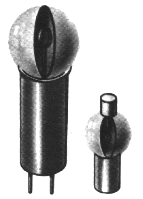
A photoelectric cell makes it possible to reconstruct the sounds recorded in the films of the cinematograph. In addition to the photoelectric effect, studied in this chapter, called the external photoelectric effect, there is also the so-called internal photoelectric effect, typical of semiconductors, widely used, for example, in photoelectric resistances, that is, electrical devices whose resistance depends on the intensity of the illumination. It also applies to semiconductor photoelectric devices that directly transform light energy into electrical energy. Such devices can serve as a source of electric current, allowing to assess the intensity of illumination, for example, in photometers. The same principle is based on the operation of solar cells, which are equipped with all cosmic ships .
2) The sensitivity of the electrical resistance (R) of an LDR device. (light-dependent resistance) for different values of the wavelength of the incident light. The operation of this device is based on the photoelectric effect. When illuminated, for example when exposed to the sun, the device has a lower electrical resistance, since it now has free deelectrons due to the action of the incident light, as illustrated in the following figure. The resistance of the LDR increases enormously in the absence of light, for example at night, since free electrons are missing. Note that the maximum sensitivity of the LDR resistance is in the visible light range (4000 to 7000 A). The base material of the LDR is the sulfide of 124 Valadares, EC et al-cadmium (CdS) which is sensitive to light in the visible range. For other applications (for example in the infrared range, as in the case of the television remote control) it is necessary to use other materials (for example gallium arsenide).
One application: principle of operation of the public lighting system.
Fig. 1: During the day, sunlight promotes electrons in the LDR connected to
free electrons, as indicated above. The electrical resistance of the LDR becomes lower and the electric current passes through the coil, generating a magnetic field, as if it were a magnet. The relay switch is then drawn to position 2, preventing electrical current from passing through the lamp filament. Other applications of the photoelectric effect: automatic control of elevator doors and supermarket treadmills. In this case, a beam of light, when interrupted, activates an automatic system that opens the elevator door or moves the conveyor.
Fig. 2: At night, the electrical resistance of the LDR is high because sunlight is not present, preventing the electric current from passing through the coil, which no longer acts as a magnet. The spring then forces the relay switch to return to position 1, activating the lamp, which will automatically go out the next day, once the circuit
returns to the situation shown in Fig. 1.

