
ATOMIC MODELS
One of the great contributions of quantum mechanics was the better interpretation of phenomena on the smallest scales known to science until then, the atom. The physicist who managed to give a quantitative explanation for the atom was the Danish Niels Bohr, but to understand what was his contribution to the atomic structure, let's review some models made for the atom that preceded it.
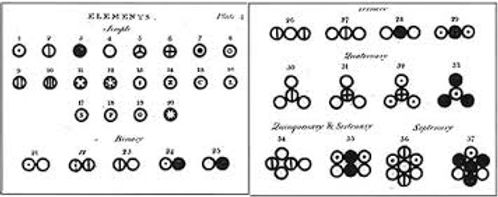
John Dalton (1766 - 1844):
John Dalton said that:
- Everything in Nature is made up of atoms
- Atoms cannot be created or destroyed. This means that the number of atoms in any chemical element should remain constant in the universe since its origin.
- Same atoms have the same properties, and different atoms have different properties. Atoms of a given element are characterized by their mass. (In the future proved otherwise, atoms are characterized by their atomic number and not by their masses).
- Atoms can combine and recombine with each other to form more stable structures, called molecules, that make up the basic structure of all substances.

JJ Thompson (1856-1940):
Thompson was able to determine the charge-mass ratio of cathode rays, proving experimentally that the "rays" were charged particles. This is considered the official discovery of the electron. The name electron comes from the Greek elektron, which means amber, the vegetable resin rubbed by the ancients with animal skins, which started to acquire the ability to attract light objects. Thompson's claim was the first experimental observation of the electrical nature of matter. The other part of the matter was composed of a positive mass, which neutralized the charge of the electrons and caused the atoms to be electrically neutral.
It was in 1898 that Thompson formulated his atomic model, in which the atom is a positive mass with negative electrons embedded. This model was christened "Raisin pudding".


Thus, Thompson's atomic model presents two fundamental innovations in relation to Dalton's atom:
- The atom has an electrical characteristic.
- The atom is available, contrary to what the ancient Greek thinkers and John Dalton himself imagined.
Rutherford (1871-1937):
Rutherford used emissions from polonium atoms, together with scientists Geiger and Marsden, and carried out one of the most important experiments in an attempt to discover the correct behavior of atoms.
The experiment consists of an emitter of particles Alpha (α) as polonium, and these bundles of particles were thrown against a very thin blade of gold. When these particles reached the blade, the particles suffered a type of deviation, few are deflected but the very little that hit the blade returned in the opposite direction. If the "Raisin Pudding" model were correct, what Rutherford and the rest of the team expected was that all particles (α) would pass through the golden plate, suffering only slight deviations, because according to Thompson's theory, neither the negative nor the corpuscles positive clouds would have sufficient mass or charge density to reflect the particles (α).


With that, Rutherford imagined that the atom would have a region much smaller than the size of the atom itself, concentrating almost all its mass in its center. The atom would be a large empty space, with electrons well away from the nucleus and with a mass practically negligible. Rutherford's atomic model is shown in the image below.

The Modern Atom:( XX - XXI ):
Other more modern atomic models, involving wave mechanics and quantum mechanics, succeeded and explained a series of flaws in the Rutherford model. One of the scientists who showed a stable and elegant shape for the atom was Niels Bohr.
Rutherford's model had some serious inconsistencies to explain the movement of electrons. According to classical mechanics, an electric particle in motion should emit electromagnetic waves continuously. This would cause the electron to lose energy until it collides with the nucleus, that is, by classical mechanics the Rutherford atom would be unstable.
Niels Bohr in 1903, interested in explaining the emission of light by excited atoms, managed to formulate a new atomic model. It was already known that visible light sources depended essentially on the movement of electrons. Electrons in atoms can be elevated from their lowest energy states to those of highest energy by various methods, such as heat or electric current. When electrons eventually return to their lowest levels, they emit radiation that may be in the visible region of the spectrum. See the model proposed by Bohr below.
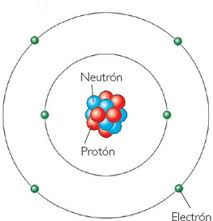

Bohr concluded that the electron did not emit radiation, as long as it remained in the same orbit, it only emitted radiation when it moved from a higher energy level to a lower energy level.
Quantum theory allowed him to formulate a conception more precisely: the orbits would not be located at any distance from the nucleus, on the contrary, only a few orbits would be possible, each one corresponding to a specific level of electron energy. The passage from an electron to an orbit would have to be made by jumping, the electron would not travel through the space between these layers, because when absorbing energy, the electron would jump to a more external orbit (concept called Quantum) and, when emitting it it would move to a more internal one (a concept known as a photon). Each of these emissions appears in the spectrum as a well-located luminous line.

With all these theories previously mentioned, such as Blackbody Radiation, Photoelectric Effect and Bohr's new atomic theory, Quantum Mechanics is well grounded in concepts and theories. After these discoveries, science took a new path in which scientists realized that in order to deal with the smallest scales like the atom or smaller than it, the laws of this microscopic universe are governed by the laws of Quantum Mechanics, laws that are completely different when it comes to the macroscopic, everyday universe, to which we will see in more detail how the continuation of this theory was and what branches it applies to.