
INTRODUCTION TO QUANTUM MECHANICS
The fundamental principles of Quantum Mechanics were initially studied from the beginning with the study of bodies, which when heated to certain temperatures emitted specific frequencies (specific colors), that is, the study of Black Body Radiation. In the mid-1750s, scientists heated different types of substances, gaseous substances and realized that the colors varied according to the substance. This procedure even helped astronomers to obtain data on the composition of distant celestial bodies through so-called spectral analysis.

100 years later, scientists were concerned with the phenomenon of radiation emissions, mainly of metals when heated, have continuous spectra as shown in the second image below, and their color showed the temperature that this body was at. After discovering this phenomenon, astronomers began to observe our Sun and realized that the solar spectrum was not continuous.
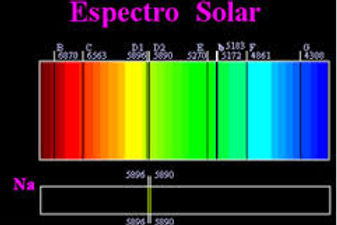

During these observations, scientists began to perceive something different and proposed an extrapolation of the theory, assuming that certain bodies absorb and emit electromagnetic radiation almost perfectly. These bodies were called Black Bodies. A Blackbody is a hypothetical body that emits (or absorbs) electromagnetic radiation at all wavelengths; in other words, all incident radiation is completely absorbed, and at all wavelengths and in all directions the maximum radiation possible for the body's temperature is emitted.