
BLACK BODY RADIATION
Before we even start talking about Blackbody Radiation, let's do a brief review on electromagnetic radiation. The following video gives us a great summary on electromagnetic radiation.
In short: Electromagnetic radiation is the definition given to waves that propagate in a vacuum or in the air at a speed of 300,000 km / s, that is, at the speed of light (c), which is also electromagnetic radiation. Another characteristic of electromagnetic waves is the ability to carry energy and information. As shown in the video above, our eyes can only see a specific range of the electromagnetic spectrum, which is called the "visible spectrum range".

Electromagnetic radiation as also said in the video propagates as a wave and a wave that contains electrical and magnetic components as shown in the review on electromagnetism. The speed of these waves is given by:
Where V is the speed of the wave, λ is the wavelength and f is the frequency at which that wave oscillates.
The higher the frequency, the lower the wavelength and the greater the wavelength, the lower the frequency, that is, frequency and wavelength are inversely proportional if one increases the other has to decrease and vice versa. See the image.
The wavelength


Relationship between frequency and wavelength


After this brief review, what does electromagnetic radiation have to do with Blackbody radiation? The answer is simple! It has everything to do, as the name says "radiation" every body that radiates has to do with electromagnetic waves. In the case of Blackbody radiation there was a theoretical problem that physicists could not explain. And what is a Black Body really? The Black Body is a hypothetical (theoretical) body that absorbs and emits radiation in all wavelengths in an almost perfect (ideal) way, in other words the Black Body absorbs and emits all types of radiation that fall on it.
According to classical theory, the theory that governed physics at that time said that the higher the temperature of a body, the lower its wavelength would be and consequently it would have a high frequency, but the theory said that the higher the temperature, the energy irradiated would tend to be close to Infinity (its value would be close to Infinity). Energy near Infinity? This makes no sense in any real physical phenomenon ...
The theoretical result that physicists found did not actually happen with the experiment, that is, something was wrong with the theory and the physicists at that time could not say why and what would be missing from the theory. This episode became known as "The Ultraviolet Catastrophe". See the graph!
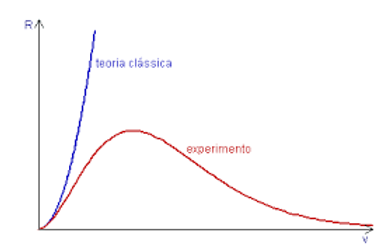
Graph shows the relationship of emitted radiation (R) with frequency relation (ν) , blue color it's Classical theory and red color it's the experiments results
In 1900 a physicist named Max Planck studied the theory in depth in order to solve the problem of the Ultraviolet Catastrophe. Planck spent practically 5 years studying the subject and, in desperation to solve the problem, he assumed that the radiation emitted was not continuous, but emitted by discrete energy packages, which completely contradicts the classic theory that said that the emitted radiation is to be continued.
Max Planck after having proved experimentally that energy was in fact emitted in packets, made the adjustments to the theory to which the graph below shows:
Max Planck after having experimentally proved that energy was indeed emitted in packets, made the adjustments to the theory to which the graph below shown in this Phet animation, and which is described by the following equation.
Where (h) is Plank's constant, (λ) is the wavelength, (c) is the speed of light in vacuum, (k) - Stefan-Boltzmann constant and (T) is the absolute temperature.
For Plank to have been able to make this adjustment, through experimental data he managed to find one of the fundamental constants of nature, which he named in his_cc781905-5cde-3194- bb3b-136bad5cf58d_homage is used in the above equation for the correction of the classical theory as we discussed:
There is also its short form, known as h "cut" or h "slash":
So with this correction proposed by Max Plank that the emission of radiation by heated bodies was not continuous but emitted by small packets multiple from your constant h. We have the necessary correction for the theory as shown in the graph below.

Graph shows the ratio of emitted radiation (u(λ)) to wavelength (λ)
The question that is on your mind now and probably on the minds of physicists at the time as well, whether the theoretical data of the Rayleigh-Jeans law (Classical Theory) _cc781905-5cde-3194-bb3b- 136bad5cf58d_ do not match the experimental results, so it should be completely discarded, as it is wrong!
No! The issue is that for bodies with very high temperatures, for the energy to be issued very intensely proportional to a temperature, the wavelength decreases more and more, that is, the frequency of wave aumenta. And the modeling done by Rayleigh-Jeans fails when we deal with very small wavelengths, which resulted in those absurd results obtained before the Max Plank correction. The Rayleigh-Jeans theory is still useful, but only for sufficiently large wavelengths where calculations do not give results like (∞).
And indeed, if we compare the mathematical modeling between the classical Rayleigh-Jeans theory and the theory quantized by Max Plank we can see that they are practically the same except for the correction factor made by Plank.
- Rayleigh-Jeans Law -
- Max Plank's Law -
Plank correction factor
Rayleigh-Jeans Factor
So this tells us that the equation ofRayleigh-Jeansis only useful for calculatingtemperature of relatively warm bodies, and that they have abig wavelength, butPlank's Lawis already a more general case, because it makes it possible to calculate thetemperature of hot and extremely hot bodies as well, which the classical theory fails to do, because forextremely hot bodies the emitted wavelength is very small, such as in the ultraviolet spectrum range, which would be invisible With the naked eye, we can still see the body with high enough temperatures illuminating and emitting radiation even reaching wavelengths within this spectrum.
Which brings us to the last law to explain, Plank's law respects an important relationship for understanding the spectral emission of bodies at high temperatures. If we look at the graph below, we can see that despite the temperatures increasing, the area below the graph covers the range of visible light (rainbow).

The important thing to do is understand in this graph is that as the temperature increases, the wavelength decreases, that is, the peak of the graph goes away shifting increasingly to the left. That consequently faz with that a emission and the energy associated with it increase as well.
The Wien shift law says that for each wavelength, there is a peak that we call ( ), where the intensity emitted per wavelength range is greatest. The graph shows that _cc781905-5cde-3194-bb3b-5bad_cf is constant equal to:
This tells us that, as the temperature of the body increases, the wavelength emitted by the thermal radiation of this body tends to become smaller and smaller, and consequently I(λ) also increases. The important thing to understand about these blackbody emission graphs is that the value of I(λ) is associated with the area of the graph below the temperature curve.
So the Intensity radiated by the body at a certain temperature and a wavelength I(λ) is numerically equal to the value of the area in the graph below, given by the relation:
- Stefan-Boltzmann law -
Where the sigma constant (σ) called the "Stefan-Boltzmann constant" has the value equal to:
For a better understanding, we have a Phet simulator below showing a graph of the emission of um body at a certain temperature. The first thing we can do is:
1) First of all, select the 3 boxes in the simulator (values, identify and intensity). Then take the temperature dial on the right side and place it exactly on Earth, and see what happens to the graph. Take a piece of paper and make a table for the values of T - (temperature), I(λ) - (radiated intensity) and λ - (wavelength), in which part of the spectrum is the point of maximum emission?
2) Now increase the temperature to the temperature of a light bulb, follow the same previous procedures in recording the temperature, intensity and wavelength values. In this graph, what are the ranges of the spectrum in which the light emits?
3) Next, raising the temperature to approximately the surface temperature of the Sun, what spectral ranges does the emission from the solar surface have? Write down the temperature, intensity and wavelength values again.
4) Finally, raising the temperature to approximately the surface temperature of the star Sirius A, which spectrum bands the emission from the surface of this star _cc781905-5cde- 3194-bb3b-136bad5cf58d_tem? Write down the temperature, intensity and wavelength values again.
5) Looking at this table of values you made leave of this blackbody emission graph. What can you see what happens to the intensity of the emitted radiation and the wavelength when the temperature increases?
6) According to the blackbody radiation emission chart, bodies emit radiation in only one spectrum band electromagnetic🇧🇷 If yes or no, justify.
Planck as shown in the video, realized that the energy was not emitted continuously, as classical physics said, the energy is emitted by small packages that he called "Quantum" who comes from Latin and means "quantity". This Quantum of energy depends on a correction finding and the frequency at which the radiation is emitted, in which he called (h) - Planck's constant in his honor. From there, Planck took the first step towards the beginning of a physics different from the one before, worrying about dealing with the smallest scales, like the atom (electrons, protons and neutrons). Through this the beginning of Quantum Mechanics.