
Quantum Mechanics in Classical Computing
The Classic Computer
How does a computer work?! You've probably asked yourself this many times! If not, today we will see how a conventional computer (classical computer) works. And then we will make a parallel of its operation with Physics.
as it is no surprise for nobody a computer does not work without electricity. This is the main point of all computing, electrical current, circuits and consequently we are moving with electrons! Yes this blessed will appear again in our theme lol
The structure of a common computer, mainly the so-called "Desktops" (desktop computers) usually has the case, monitor, keyboards and mouse, as shown below:
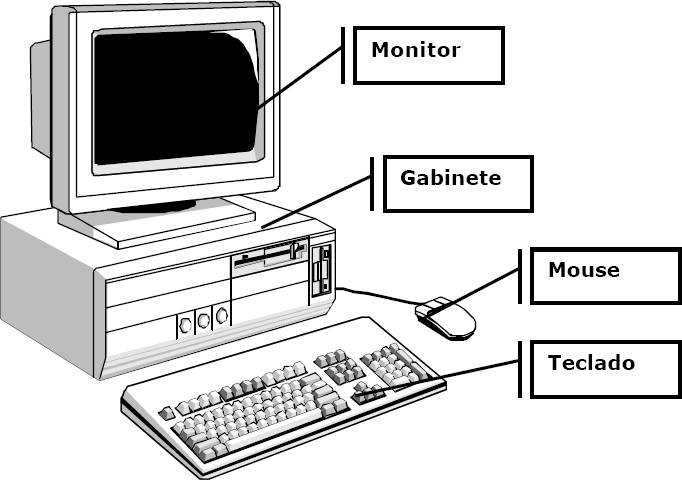
What we want to explore in more detail will be in the component called "Cabinet", where is the CPU which translated from English means (Central Processing Unit), that is, where the processor is. And what is a processor?? The processor is one of components most important aspects of the computer, without it you would simply do nothing, just a piece of metal in front of you.
We can see the processor as the "brain" of the computer, it is responsible for processing any and all types of information necessary at the user's request, from clicking the key, moving the mouse over the table, to forming the image on your monitor, everything that the processor is responsible for doing it in a fraction of a second and milliseconds . a cool example for Let's see the video below:
HAHA HA! In a very playful way, yes the processor does EVERYTHING! EVERYTHING to make things work inside the computer.
The question is how does he do it? The processor is nothing more than a calculator! And the speed with which he makes these calculations is related to the called "Clock" which in other words we can literally translate as "counter/count".
So if you, when you go to buy a computer in a store and read or the salesperson tells you that the processor of that computer is 1.2GHz or 2.5GHz what he is actually saying is the ability of this processor to do calculations, in other words , 1.2 GHz = 1,200,000,000, i.e. 1 billion and 200 million calculations per second), or as the 2.5GHz (2 billion and 500 million calculations per second) the higher the number in Hz (Hertz) the higher the calculation speed of the processor, consequently a very fast machine to perform tasks.
Oh you must be wondering... "Is the processor a calculator? But huh?!?". That's right! The difference is that the processor does a different calculation than you're probably imagining. It was designed for do the so-called binary calculation, that is, it counts a numerical sequence of 0's and 1's (Zeros and Ones). Like this?!
Every function or action that we do on our computer, cell phone, tablets, everything that involves a processor, there will be these binary calculations, and the way they work is as follows.
Suppose we want to write a text on our device, when we press a key or move the mouse, whatever action, this information is passed as a numerical sequence for the processor in the form of electric current in fraction of seconds, when there is current the processor interprets it as 1 (one) and when there is not it interprets it as 0 (zero).
So, for example, we press the letter A on the keyboard, and since nothing on the computer does not run without software (a program) mainly the base program to make everything run and mediate the interaction of the processor with the user which is the OS (Operating System), it is already contained in it that when you press A , the numeric sequence that must be generated for the processor would be for example: 01101001
This doesn't have a clear meaning for us, but for the processor it does! That's exactly what the software does, it takes an action or a command from us and sends it to the processor, and this sequence of alternating numbers from 0 and 1 as for example given before, the processor will understand as A , and in a matter of milliseconds it does the calculations and will return to the text software (Word, Notepad, etc.) that the action performed by the user (you) was to press the letter A.
Yea! I think with this example you already gave for imagine the complexity and importance of the processor in electronics. But the intention here is not you do understand in detail how a computer works, in fact it's not just the processor that does all this, there are of course several other components that mediate all this complexity that our machines do, without wanting to worry about all that happens inside these hulls of metal and plastic lol. As usual below will be a video explaining what binary code is, just out of curiosity! There will also be some interesting information omitted in the explanation here, so stay tuned :)
OK! Nice! But what does Quantum Mechanics have to do with it? Electromagnetism also studies currents, circuits and electrons. Wouldn't this theory alone be able to create a processor? The simple and short answer is NO!
Quantum Mechanics already enters the fundamental question of creating any type of electronic, the material that is made. It is not just any board that is placed connecting wires and causing downloads electrical, is a specific material in which it is neither a conductor nor an insulator, it is a semiconductor. Not just the material itself, but even the geometry and shape of the components are atomically architected for the best processing efficiency. In order for us to understand better visually what do we explain we have the following video: OBS - Activate the subtitles!
Now understanding the basic functioning of a computer, we were able to move forward with a similar subject, but as usual with different rules and a new concept that we will deal with in the next topic.
The point is that, with the advancement of scientific knowledge, practically everything we have around us today was influenced by these new discoveries. Regarding computing that is not from the time before the 2000s, you probably have no idea how to use a floppy disk, a cassette tape, among others. trinkets we had to store and process information compared to what we have today.
It is evident that as the years go by the capacity of the machines around us has increased significantly in power and they are getting smaller and smaller in their physical size, as already predicted by Gordon Earle Moore, one of the founders of the processor company, Intel. In which he created a law in his name, Moore's Law.
Moore's Law has become so important that it is not only used as a goal to be pursued and beat each year, but also as a means of verifying that the industry is evolving at the expected speed. Although Moore is very correct in his predictions, everyone knows, including himself, that this growth will not last forever. Transistors today are in the 25 nanometer scale. This is the same scale as some viruses and bacteria.
Reducing more than that is becoming more and more difficult. Researchers and scientists are looking for other ways to make computers keep evolving at their speed and reducing their size. Some think of replacing silicon transistors with other materials, such as graphene.
One of the alternatives that scholars in the area have been thinking about for the future of computing is the Quantum Computer that we will talk about in the next topic and Bio Computers.