- ELECTROMAGNETISM -
For Electromagnetism, James Clerk Maxwell, as well as Newton and Boltzmann, made the unification of some other works made from the researches carried out by several scientists and scholars who have studied the phenomena of electricity and magnetism, such as by Hans Christian Oesterd, Michael Faraday , André-Marie Ampère, George Simon Ohm and Willian Sturgeon. The great work done by Maxwell was to give science a better understanding of how electrical and magnetic phenomena really worked and what was the relationship between these two areas studied by physics.
In the past, it was believed that magnetism and electricity were part of different facts. The studies of important researchers, such as William Gilbert, Otto von Guerick and Stephen Gray, during the 17th and 18th centuries, aimed to explain these phenomena separately.
Foto de James Clarck Maxwell
The experiments carried out by scientist scientists had logical results, which contributed to the evolution of research. Even with the differentiation between these two phenomena, it was believed that there was some relationship between them.
Around 1820, the scholar Hans Christian Oesterd managed to discover the relationship between electricity and magnetism through the invention of electric generators. The invention allowed the production of stable and long-lasting electrical currents, fundamental for the research of these phenomena.
Oesterd's experiment was very simple, however, with a very powerful scientifically-inclusive colclusion. The scientist approached a magnetic needle, a compass, an electrical conductor, which was a platinum wire in circuit. The choice of platinum wire is due to the fact that it guaranteed the necessary intensity for the study. When the compass was close to the wire, the magnetic needle deviated from its original position.
This experiment proved that the electric current produces a magnetic field. In 1831, Michael Faraday also managed to produce electric current, however, this result was obtained from the variation of the magnetic flux. Faraday used two coils and an iron core for his studies. During the experiment, the physicist realized that when turning on or off one of the source coils, an electric current passed through the other coil. From this, Faraday concluded that the electric current originated because of the variation of the magnetic field, a phenomenon called Faraday's Law or magnetic induction.
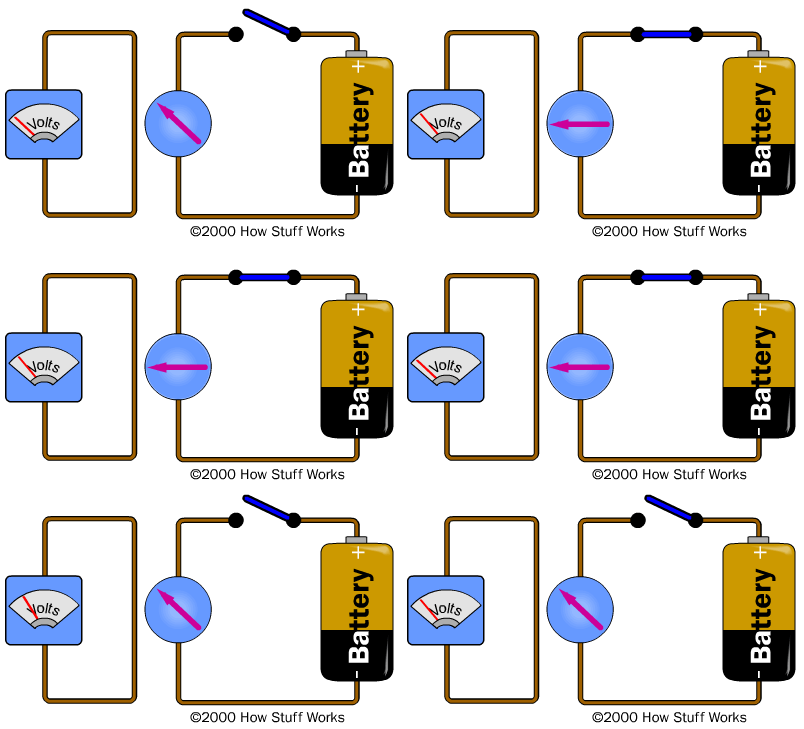
Oesterd's experiment
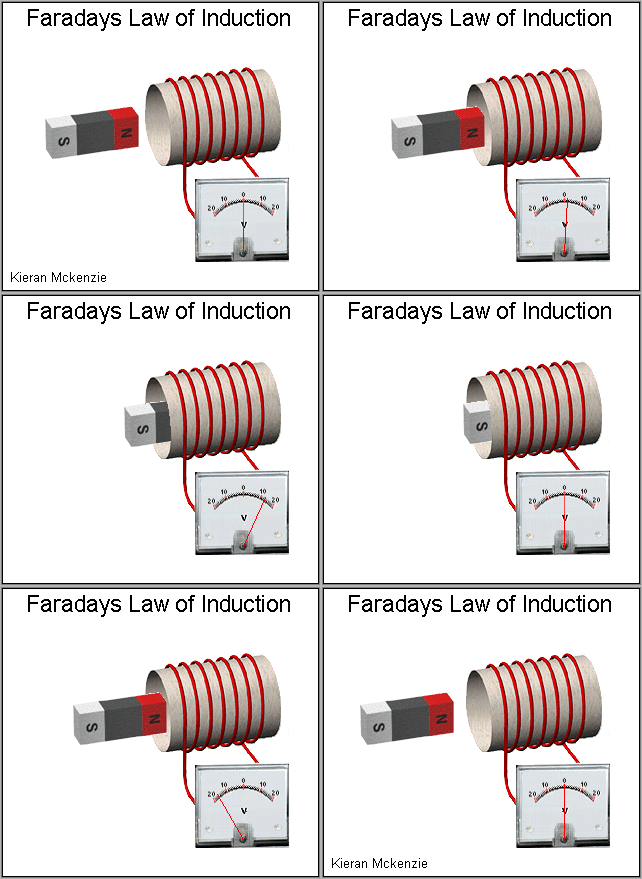
Faraday's experiment
In 1861, Physicist and Mathematician James Clerk Maxwell gave rise to the phenomenon and theoretically coined the idea of electromagnetism. His contributions were so important that, in the field of electromagnetism, Maxwell is as respected as Isaac Newton in Mechanics. Through the equations developed by Maxwell it was possible to demonstrate that the magnetic and electric fields were, in reality, manifestations of the electromagnetic field.
In the middle of the 19th century, the study of wave propagation in an elastic medium (for example, the propagation of sound in the air or in another material medium) was a well-developed field of research and the equations that describe these phenomena were already known. In addition, the fact that light has a wave-like behavior, that is, it spreads like a wave in an elastic medium (ether), was also known and accepted by physicists of the time. One of the issues discussed was to know how to know what this wave would be like and what were the properties of the ether.
Maxwell realized that the vortex electricity present in his mechanical model could be useful for relating optics to electromagnetism and electromagnetism. After obtaining the equations of motion for his vortex and particle system, Maxwell set out to determine how quickly disturbances propagate through him in the form of waves. These waves would be electrical and magnetic magnetic disturbances that would propagate through the ether. These are called "electromagnetic waves".
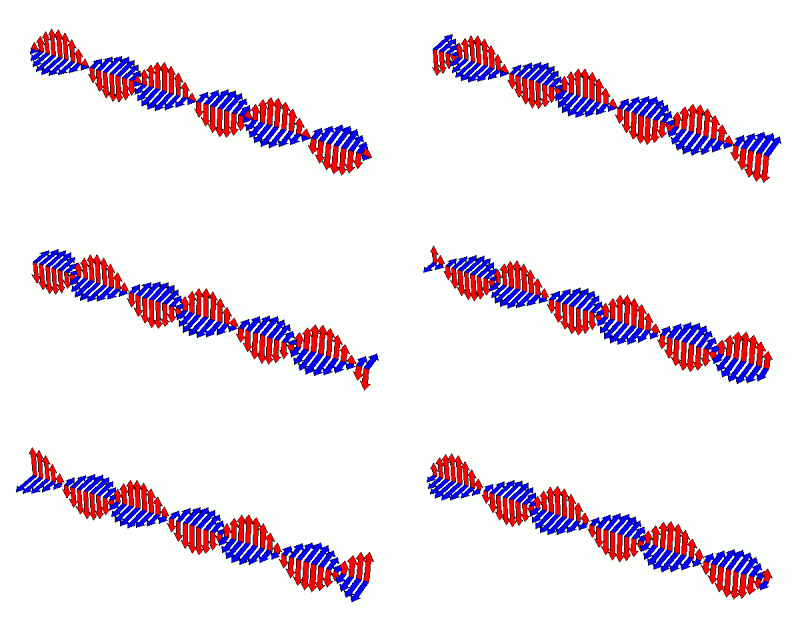
Representação das ondas Eletromagnéticas se propagando pelo espaço
Equações de Maxwell para o Eletromagnetismo na forma integral
Maxwell compared these results with the values measured for the speed of light propagation available at the time, finding a great agreement between the values calculated for the speed of propagation of an electromagnetic wave in the ether with the values measured for the speed of light propagation. Observing this agreement, Maxwell concludes that light is a transverse-transverse vibration that propagates in the same medium as electrical and magnetic phenomena.
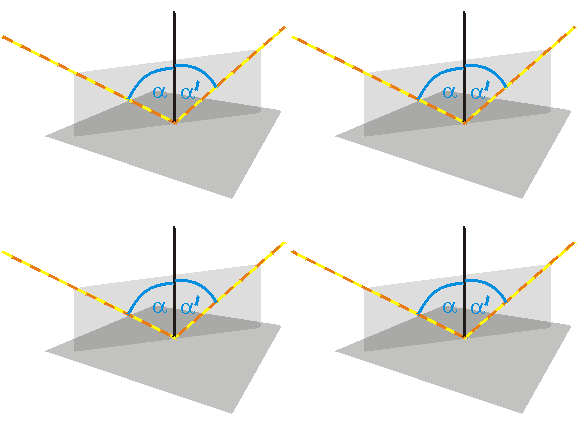
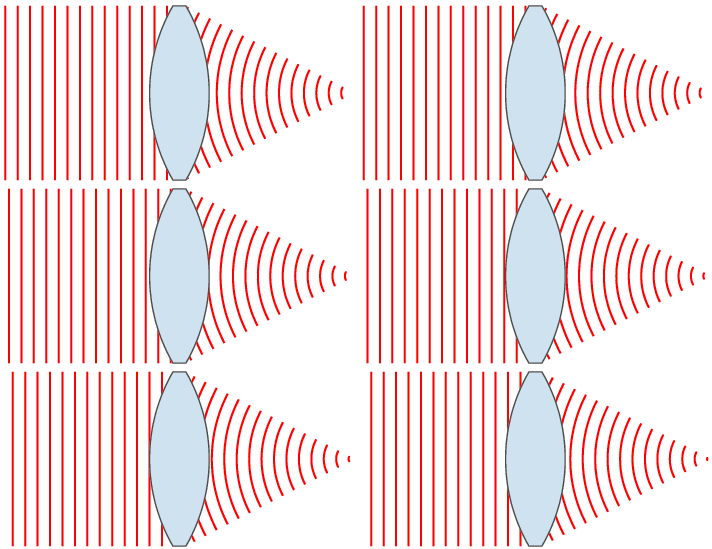
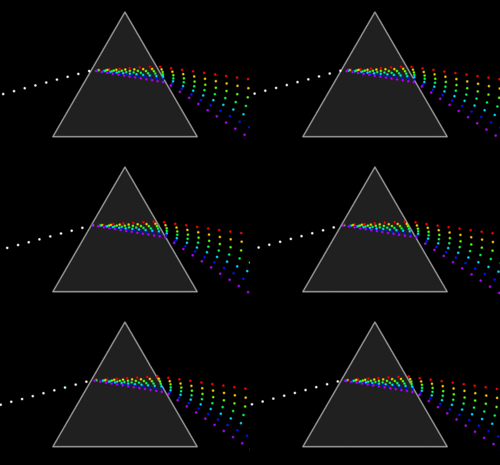
This hypothesis was confirmed experimentally by Heinrich Rudolf Hertz (1857 - 1894) through and through several experiments carried out between 1886 and 1889. He produced, produced and detected electromagnetic waves that propagated with the speed of light and that had properties similar to those of light, such as, reflection, diffraction, polarization. Maxwell's theory and Hertz's experiments opened an important field of studies that provided great technological advances: the study of electromagnetic radiation in the range of radio waves and microwave microwaves.
Diffraction
Reflection